Welcome to TOVISEN
Can a Mini Skid Steer Move Landscaping Boulders?
Yes — a mini skid steer can move landscaping boulders, and for many residential jobs it is the right machine for it. What decides the job is not horsepower but the match between the stone and the machine's rated load. A compact wheel machine like the TOVISEN S370 carries a rated load of 350 kg (about 770 lb), which covers the decorative boulders and fieldstone that dominate front-yard work — but not every rock that looks manageable on a quarry yard. Here is how to size the stone honestly, pick the right attachment, and set it without tearing up the site.
How heavy is that boulder, really?
Boulders are deceptive: a rock that two people can roll on the ground can weigh far more than they can lift. Landscape stone is estimated by volume and density — granite runs roughly 165 pounds per cubic foot, limestone and sandstone closer to 140–155. A textbook 2 × 2 × 2 ft granite block is about 1,300 lb, and natural, rounded boulders of the same dimensions come in somewhat lighter because of their shape. The safe habit is to measure the stone's three dimensions at the quarry, multiply conservatively, and assume the heavier number. If the estimate exceeds the loader's rated capacity, the stone gets split, reselected, or handled with a bigger machine — not "tried once."
Matching the stone to the machine's rated load
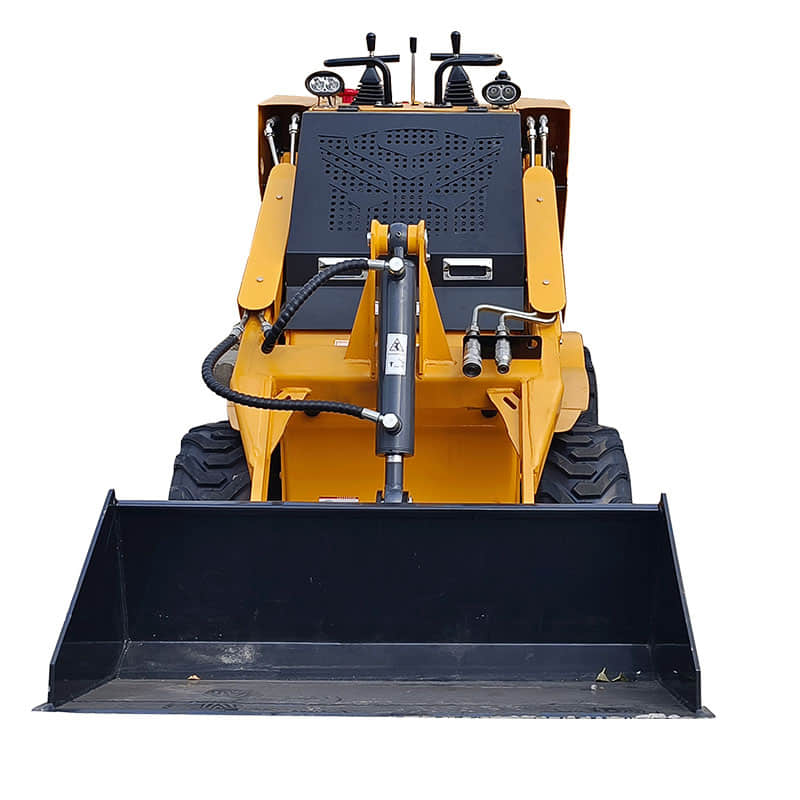
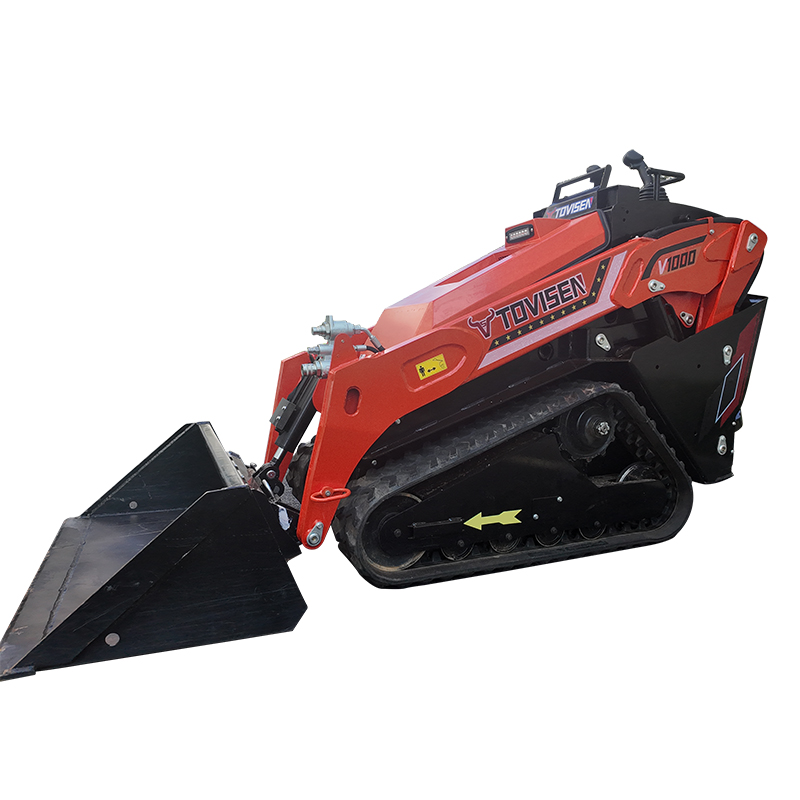
The TOVISEN S370 is sized for exactly this class of work: a 350 kg (770 lb) rated load, a 0.27 m³ (9.5 cu ft) bucket, a 1,020 kg (2,250 lb) machine weight and a 1,070 mm (42 in.) overall width on a 2,138 mm (7 ft) chassis, so it works between fence lines and garden beds where a full-size skid steer chews up turf. Rated load means the weight the machine can carry and still steer and stop predictably — not the most it can momentarily drag. For boulder work that translates to stone in the several-hundred-pound range, lifted low and traveled slowly, with the load kept against the bucket and near the ground. The S370's counterbalance arm design puts that weight distribution where it helps material handling, but no machine compensates for an overloaded bucket turning across a slope.
The attachment matters as much as the stone
A plain bucket can push and roll a stone all day, but it is the worst tool for picking one up cleanly. A grapple-style bucket clamps the rock so it cannot roll off when the arms lift; pallet forks work for stone delivered strapped on pallets; and a tooth bar or tooth bucket bites into the pit edge when seating the stone. The S370 works with TOVISEN's skid-steer attachment range, so the bucket and the grapple go on the same machine — one unit covers the dig, the carry, and the set.
Setting the stone without damaging the site
Placing a boulder is excavation work, not just lifting. The stone is normally seated with roughly a third of its height below grade, on a compacted angular-gravel base so it does not sink or shift with frost — which means digging a pit first. Before that pit is dug, the utilities have to be marked: in the US that means an 811 locate request before any digging, and professional excavators are expected to give notice and provide accurate site information so the lines get marked in time (811 Before You Dig, Tips for Excavators). A 500-pound stone set on top of a shallow gas or fiber line is a very expensive landscape feature. Keep bystanders clear while the stone is in the air, and never let anyone steady a hanging rock by hand.
When to size up instead of forcing it
The honest limit is the rated load. Stone above the machine's capacity calls for a larger loader in the same compact class, a second lift with the stone split, or old-fashioned rigging — sled, rollers, and a winch — for the final inches. What does not work is exceeding the rating and hoping: overloaded loaders lose steering on soft ground, and a raised, overloaded bucket is the classic tip-over setup. For crews that regularly set large stone, stepping up to a higher-capacity machine in the same lineup costs far less than one overturned loader.
FAQ
Can a mini skid steer lift a 1,000-pound boulder?
Not on a machine with a 770 lb rated load — 1,000 lb exceeds the rating before you account for the grapple's own weight and any margin for uneven ground. Machine ratings are a working limit, not a maximum stunt figure. Split the stone, reselect a smaller one, or bring in a loader with a higher capacity for that piece.
Should I use a bucket or a grapple for boulders?
A grapple, whenever one is available. It clamps the stone so it cannot roll off the bucket during the lift or while traveling, which is exactly the failure mode that damages machines and turf. A plain bucket is fine for nudging and rolling a stone into its final seat, and pallet forks suit pallet-delivered stone — swapping attachments on the same machine keeps the crew moving without a second unit.
Quoting a hardscape or boulder install? Send TOVISEN the stone sizes, site access width, and your ZIP code through the contact page — the factory team will match the S370 or a higher-capacity model to the job and quote direct. More machine photos and jobsite clips are posted on our TOVISEN Facebook page.

Product display photo, not a customer jobsite.

Product display photo, not a customer jobsite.