Welcome to TOVISEN
Can a Skid Steer Clean Up Fall Leaves?
Yes — for half-acre lots and larger, a skid steer with a bucket clears fall leaves faster than rakes and backpack blowers combined, and it hauls the piles away in the same pass. On a small urban lawn, a blower is still the right tool. Past roughly an acre of trees, the machine wins every time.

Why Leaves Have to Go (It's Not Just Looks)
A thin scattering of leaves gets chewed up by the mower and disappears into the turf — that's free organic matter. But a mat of whole leaves is different. It blocks light, traps moisture against the grass blades, and packs down into a soggy layer that invites snow mold and vole damage through winter. Turf that goes into winter smothered comes out thin and patchy in spring, which means overlap-seeding and extra fertilizer you didn't plan for.
Clemson University's composting guide also points out that leaves are a resource, not trash: they're one of the best "brown" (carbon-rich) ingredients for compost. That changes the goal from "get rid of leaves" to "collect and relocate them" — which is exactly what a bucket is built for.
Skid Steer vs. Blower vs. Truck Loader
A crew clearing leaves by hand works in three passes: blow everything into windrows, vacuum or bag it, and truck it off. Each pass costs labor hours. A skid steer collapses that into one: the bucket pushes the windrows into piles and dumps them directly into the trailer or the compost area. On properties with long fence lines, wooded edges, or a distant disposal pile, the hauling — not the blowing — is where the hours go, and hauling is what the machine eliminates.
The honest trade-off: a skid steer can't detail around flower beds, AC units, or pool fences the way a hand crew can. Big properties run both — machine for the open ground, one person with a blower for the edges.
The Bucket Method, Step by Step
1. Blow leaves into windrows first, same as you would for a vacuum crew. Long, straight rows beat scattered piles.
2. Work with the wind, pushing rows into bigger piles downwind. Dry leaves blow away faster than they load — damp mornings are actually easier.
3. Keep the bucket flat and skim, don't scoop. Pushing with the blade edge on grade picks up leaves and leaves the turf. Digging in loads half soil, half leaves and scalps the lawn.
4. Load partial buckets. Leaves are voluminous but nearly weightless — a heaping bucket spills more than it carries, especially over any distance.
5. Dump at the compost area or trailer in one loop, and keep the pile tight. Wind-scattered piles need collecting twice.
Don't Haul Them to the Curb — Compost Them
Fall leaves are pure carbon: Clemson's composting factsheet lists them at a carbon-to-nitrogen ratio of 30–80:1, which is why a leaf-only pile sits there for a year doing nothing. Mix leaves with a "green" — grass clippings from your last mows are ideal at 15–25:1 — to bring the overall ratio near the ideal 30:1 and the pile heats up within days.
Three rules keep the pile cooking instead of rotting: keep it between roughly 3 and 5 cubic feet (smaller piles lose heat, bigger ones starve for air), keep it moist like a wrung-out sponge, and turn it once a week to feed the microbes oxygen. Turned and moistened, leaves become usable compost by planting season — free soil amendment instead of a disposal bill.
Which Machine Fits the Job
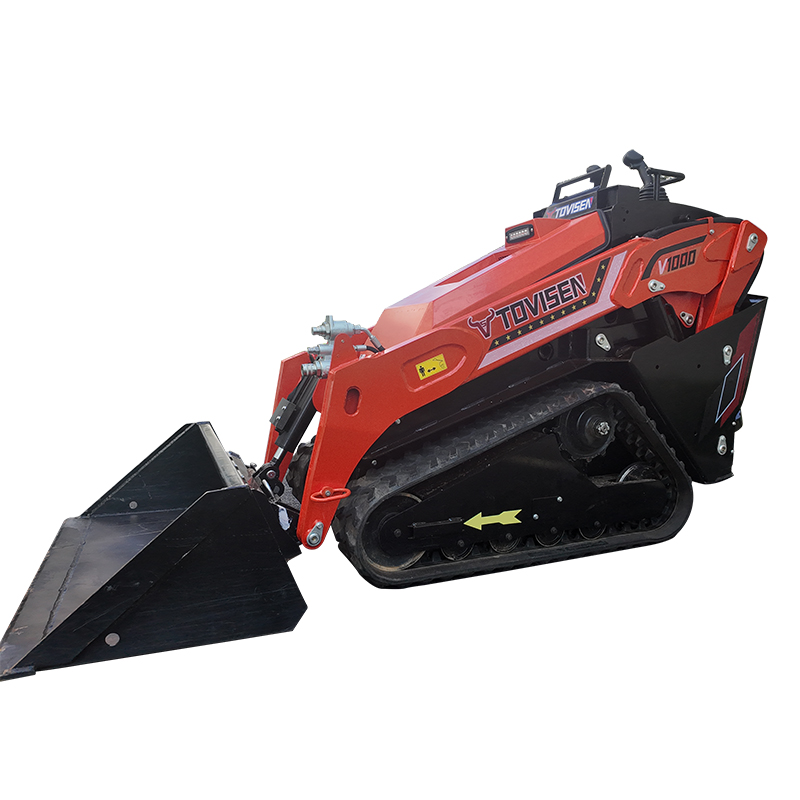
For leaf duty, weight matters less than width and traction: you're working on finished turf, often in damp conditions. The TOVISEN V800 crawler skid steer loader runs on rubber tracks instead of wheels, spreading its 1,635 kg over more ground so it floats on soft autumn lawns instead of rutting them. The Kubota D1105 diesel sips fuel through long cleanup days, and at 1,270 mm wide it fits through garden gates to reach backyard piles. Its 0.15 m³ bucket is the right size for leaf volume without becoming a sail.
Want to see which attachments pair with it for leaf season and year-round work? Send us your property size and tree cover and we'll spec the machine and attachments — factory direct.
FAQ
Can I just leave the leaves on the lawn over winter?
Only if you run them over with a mulching mower until they're in small pieces. Whole leaves mat down, block light, and set up snow mold. If you can see distinct leaves lying on the grass after mowing, they still need to be removed.
Will the bucket tear up my grass?
Not if you skim with the blade flat on the surface instead of digging in. On soft or sensitive turf, work when the ground is damp-firm (early morning), keep turns wide, and remember tracks — like the V800's rubber track system — leave far less imprint than wheeled machines.